
Dr Anupam Sinha
BDS, MDS - Orthodontics
- Delhi State Dental Council registration number A-6723 (2015).
All-on-6 dental implants · Greater Kailash 1, Delhi
Orion Dental Clinic is a dentist in Greater Kailash 1 (GK 1), South Delhi. All-on-6 replaces the teeth in one jaw with a fixed set of teeth held by six implants, which share the biting load between more posts than the four-implant design. This page explains how it works, who it may suit, how long it takes, how recovery goes and what the research shows, in plain language, so that you can decide with confidence.
Treatment is planned by Dr Anupam Sinha (BDS, MDS) and Dr Natalia DeSilva (BDS, MDS). For the wider picture, read our guide to full mouth dental implants. Ask as many questions as you need before you decide.
These figures come from a review of 54 studies of fixed and removable sets and from NHS hospital leaflets, listed at the end of the page. They are not specific to six implants. Your dentist will give the timeline for your own mouth.
Medically reviewed by Dr Anupam Sinha, BDS, MDS - Orthodontics, .
Quick answer
All-on-6 at Orion Dental Clinic in Greater Kailash 1, Delhi replaces the teeth in one jaw with a fixed set held by six implants. Dr Anupam Sinha and Dr Natalia DeSilva plan each case after an examination and a 3D scan. It needs enough bone for six implants, and the final teeth are fitted after months of healing.
01 Overview
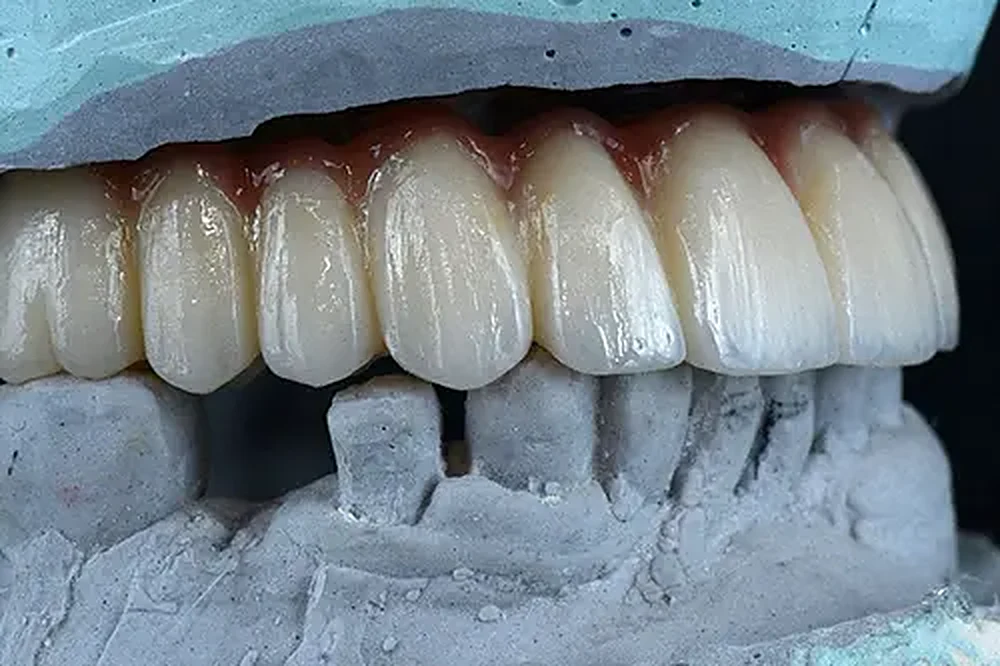
All-on-6 is a way to replace a whole arch of teeth with a fixed set carried by six titanium implants. The implants are placed in the jawbone and bond to it over the following months, and a full set of teeth is then attached to them with screws or cement. Only the dentist can remove the set, so you clean it in place.3
Six implants are used instead of four to share the biting load between more posts, and they need enough bone in enough places. In one large review, lower-jaw fixed sets on five or more implants lost fewer implants than sets on four.1 Another review found no link between the number of implants and implant survival in the lower jaw.2 The research does not give one answer for every mouth, so the number is planned for you.
All-on-6 is one design within full mouth dental implants. The four-implant version is explained on our All-on-4 page.
Six implants give the plan more support, but only if your bone has room for them.
02 Candidacy
All-on-6 is planned for adults who have lost most or all of the teeth in a jaw and whose bone can carry six implants. Because it is major treatment, your dentist decides after an examination and a 3D scan, and may suggest dealing with other problems first.3
Whether there is room for six implants decides if All-on-6 is possible, and your gums and health decide when.
03 Options
Fixed teeth on four or six implants, or a denture that clips onto implants, are the usual choices when most teeth in a jaw are missing.
Six implants carry a fixed set of teeth that only the dentist can remove. The load is shared between more posts, and bone has to be available for all six.
Six implants per jaw
Four implants carry the fixed set, often with the back two tilted so that they use the bone that is there.
Four implants per jaw
Healing time is similar for each design, because the bone needs three to six months to bond to the implants.3 Ask whether a fixed temporary set of teeth is possible while you wait.
| All-on-6 | All-on-4 | Overdenture | |
|---|---|---|---|
| Implants per jaw | Six | Four | Often fewer |
| Can you take it out? | No, only the dentist can | No, only the dentist can | Yes, to clean it |
| Spread of the biting load | Over six posts | Over four posts | Shared with the gums |
| Research on implant loss | Fixed sets on five or more lower-jaw implants lost fewer implants than on four 1 | Four implants lost more in the same review 1, but not in another 2 | Higher loss with fewer implants in the same review 1 |
The decision between four and six implants rests on your bone and your bite, and the research does not settle it for every mouth.
04 Procedure
Every case is planned individually, so your steps may differ. This is the usual order.34
Most of the time is spent waiting for bone to heal, and the final teeth are adjusted over several visits.
The dentist asks about your health and medicines, examines your mouth, gums, remaining teeth and any denture, and takes a 3D scan. The scan shows whether there is bone for six implants and where nerves and sinuses lie.
Gum disease and decay are treated first, and teeth that cannot be saved are taken out, which is tooth extraction. Removal may come before the implants or at the same visit.
If there is not enough bone for the posts, a bone graft may be done first. NHS patient information says this can add at least four months to treatment, and that it can bring swelling, bruising and pain.34
The area is numbed with a local anaesthetic, and some people also have sedation. The dentist places six implants along the jaw and closes the gum around them or fits healing caps. Ask about sedation dentistry if you are anxious.
A temporary set of teeth or denture bridges the healing period, and it may need adjusting.3 The bone bonds to the implants over about three to six months, and longer if a graft was needed.
When the implants are firm, impressions are taken and the final fixed teeth are made to match your bite and your face, then fitted and adjusted over later visits.
NHS guidance advises monitoring every three to six months over the long term.3 Your dentist checks the gum around each implant, the bite and the teeth, and shows you how to clean beneath them.
05 Aftercare
Healing after six implants runs in four stages. Your own written instructions from the dentist take priority over anything general on this page.
Expect some bleeding, swelling and tenderness.3 Rest, eat cool, soft food, take your medicines exactly as prescribed, and do not smoke.
Swelling and bruising begin to ease. Stay on the soft food plan, rinse only as instructed, and come back for your follow-up so the stitches and the temporary teeth can be checked.
The bone is bonding to the six implants. Keep brushing, clean the temporary teeth the way you were shown, attend each review and avoid tobacco.
Brush twice a day and clean beneath the fixed teeth with interdental brushes or the aids your dentist recommends. NHS guidance suggests a check-up every three to six months.3
Call the clinic on 098115 01995 the same day for loose or broken temporary teeth, a screw that moves, bleeding that continues after 20 minutes of firm pressure, swelling that is still growing after day three, a fever, pus or a bad taste, or pain that medicines do not control. Numbness in the lip, chin or tongue that persists needs a call as well. For trouble breathing or swallowing, or swelling that spreads towards your eye or neck, go to a hospital emergency department.
Follow your written instructions, keep the area clean and call early if something feels wrong.
06 Limits and risks
All-on-6 is major surgery, and it does not suit everyone. A good dentist will say no, or wait, when another route would serve the patient better. These are the situations in which your dentist may advise a different option, a delay, or advice from your other doctors:
In these cases four implants, a denture clipped to a few implants or an ordinary denture may be the better first step, or implant treatment can start once another problem has been dealt with.
An implant may not bond. A review of 54 studies of fixed and removable sets estimated that 97.9 percent of upper-jaw implants and 98.9 percent of lower-jaw implants were still in place after five years.1 A separate review of 17 lower-jaw studies found that between 98.42 and 98.93 percent were in place at five years and between 96.86 and 97.88 percent at ten.2 NHS guidance says smokers have a much greater failure rate.3
The research on six against four is mixed. In the larger review, lower-jaw fixed sets on five or more implants lost fewer implants than sets on four.1 In the lower-jaw review, the number of implants and how they were spread made no difference to implant survival.2 Neither review compared six implants with four directly in your jaw, so your dentist plans from your scan.
The gum around an implant can become inflamed. A review of 11 studies found that on average 43 percent of patients had inflamed gum around an implant and 22 percent had the more serious form that destroys bone, with wide differences between studies.5 Inadequate cleaning can lead to long-term bone loss.3
Surgery has its own risks, and parts wear. Swelling, bruising and discomfort are common for a few days, and infection can occur. Altered feeling or numbness in the lip or chin is very rare and usually settles.3 Teeth, clips and screws can loosen or wear out and may need repair or replacement.34
A good plan names these risks before treatment starts, and a good clinic keeps checking the implants and the teeth for years afterwards.
07 Your visit
At your first visit, a dentist at Orion Dental Clinic asks what you would like to change about your teeth or denture, and about your health, medicines and smoking. Bring recent X-rays, your denture if you wear one, and a list of your medicines.
The dentist examines your mouth, gums and remaining teeth and takes a 3D scan. You then hear whether the bone allows six implants in the jaw, how that compares with four, whether temporary teeth are possible after surgery, and what the risks and upkeep are.
The first visit is for questions and a plan, and you decide at your own pace.
08 Why this clinic
The doctors who plan your treatment are the ones you meet, and you can ask them why six implants would suit your jaw. Their profiles below are taken from their own pages.
Dr Anupam Sinha
BDS, MDS - Orthodontics

Dr Natalia DeSilva
BDS, MDS - Oral Medicine and Radiology
Both Dr Anupam Sinha and Dr Natalia DeSilva treat patients who need implants, and reviews from patients mention each of them.
Whether a jaw can take six implants is judged from a 3D scan. Imaging is available on site, and Dr Natalia DeSilva has studied CBCT 3D imaging.
Patients come to Delhi from other cities and countries, and Dr Natalia DeSilva also treats Russian-speaking patients.
Ask why six implants, or four, is the right plan for your jaw.
09 Reviews
“I went for a consultation with Dr Natalia. I was very happy with her services. She was kind and very professional. I had multiple implants in the past and I could easily see she could handle complicated dental situations. Thank you Dr. Natalia for your help! I highly recommend Dr. Natalia as well as her dental clinic.”
“Very professional and a great job done with my implant. I can barely feel it!”
“I love the hospitality and line of explaination and treatment. They are really good and I highly recommend them. Dr Natalia and her team is fabulous”
10 Visit us
Mon to Sat, 9:30 am to 8:00 pm
Orion Dental Clinic Basement, E 75, Greater Kailash-1,| Monday to Saturday | 9:30 am to 8:00 pm |
|---|---|
| Sunday | Closed |
If you are looking for all-on-6 dental implants in Greater Kailash or nearby, Orion Dental Clinic is in the basement of E 75, Greater Kailash Enclave 1 (GK 1), opposite Anubhav Play School, with the entrance at Gate 1, so call or message us on WhatsApp to book an appointment and use the map for directions. More about the clinic: dentist in Greater Kailash.
11 Travelling patients
All-on-6 needs several months of healing, so most patients from outside Delhi plan it in stages: an evaluation, a surgery visit, healing at home, and a return trip for the final teeth.34 NHS hospital guidance puts the whole process at 6 to 12 months, and another hospital says at least a year.
Tell us where you live and how long you can stay, and we will explain what fits into a short visit and what has to wait. You can read how dental tourism in Delhi works, or go to our page for international patients having dental implants.
Plan All-on-6 as a staged treatment over many months, not a single trip.
12 Questions
It is a fixed full arch of teeth carried by six implants in one jaw. The implants bond to the bone over several months, and only the dentist can remove the teeth.3
Yes, a plan can cover the upper jaw, the lower jaw or both, depending on the teeth you have lost. Your dentist will explain whether to treat both at once or in stages, and how many visits that means.
The area is numbed with a local anaesthetic, and the aim is that you feel no pain during the procedure. Afterwards, swelling, bruising and discomfort are normal for a few days.3 If you are anxious, ask about sedation or read about dental anxiety.
Often yes, but the treatment is done in stages over many months. Your dentist will say which steps need you in the clinic and which can wait. Message us to plan the visits.
Orion Dental Clinic is an all-on-6 dental implants clinic in Greater Kailash 1 (GK 1), in the basement of E 75, Greater Kailash Enclave 1, opposite Anubhav Play School, with the entrance at Gate 1. Patients come for all-on-6 dental implants in Greater Kailash from Kailash Colony, CR Park, Nehru Place, Lajpat Nagar, Defence Colony and South Extension. Call or message us on WhatsApp to book an appointment.
13 Second opinion
If you are comparing All-on-4 with All-on-6, or have been told you need six implants, you are welcome to ask for a second opinion. Bring your X-rays, scans or reports. The doctors will examine you, explain how your bone and bite decide the number of implants, and describe the alternatives. Message us on WhatsApp or call; there is no form to fill in.
14 Related
Read this for a fixed set of teeth on four implants in one jaw.
Read this for the wider guide to replacing most or all of the teeth in a jaw.
Read this to compare implants with ordinary removable dentures.
Patient guides
A planning checklist for all-on-4 dental implants covering your bone, health, gums, bite, temporary teeth, healing, cleaning and the questions to ask.
What full-jaw implant surgery involves, how fixed teeth are carried on a few posts, how long it takes and what to ask before you decide.
The situations in which a dental implant is worth considering, what to weigh before deciding, and the signs that a missing tooth needs replacing.
This page is general information, not a diagnosis or a substitute for an examination, and results vary between patients.